
Find data with one click on the map.
AQLITY Vector.
The Humanitarian Intelligence platform.

AQLITY Vector is a Humanitarian Intelligence Platform designed to act as a force multiplier and integration engine for operational organizations. By functioning as a connective layer across the sector's existing digital infrastructure, the platform is completely free to use and register, democratizing access to complex humanitarian data.
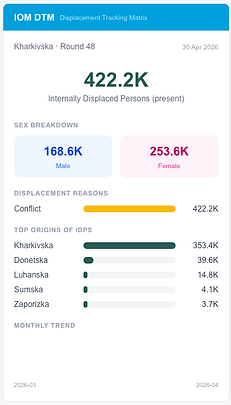
The humanitarian sector frequently struggles with a "Structural Data-to-Action Gap," where high-quality intelligence is scattered across isolated silos such as ReliefWeb, the Humanitarian Data Exchange (HDX), ACAPS, and IOM DTM.
AQLITY Vector addresses this systemic failure by transforming dispersed data into a unified, queryable interface, drastically reducing the manual "grunt work" of searching, cross-referencing, and downloading documents.
Core Platform Features (Available Now)


For our initial launch, AQLITY Vector focuses on maximizing the utility of existing databases through a high-speed intelligence retrieval layer.
-
Centralized Intelligence Retrieval: The platform connects to live humanitarian APIs, starting with ReliefWeb, to scan thousands of existing reports and surface the right documents instantly based on robust metadata.
-
Geospatial Compatibility: Geographic filtering is strictly locked to official Admin 1, Admin 2, and Admin 3 boundaries. This ensures all search results are spatially compatible with the Common Operational Datasets (CODs) used by OCHA and government partners.
-
Relevance Confidence Meter: The retrieval interface includes a visual indicator showing exactly how closely a retrieved document matches your specific query, helping users distinguish between exact hits and related context.
-
Interoperable Data Exports: Data officers can export cleaned, harmonized datasets in CSV or JSON formats, making the data instantly accessible and usable within standard industry tools like PowerBI, ArcGIS, or Tableau.
Future Roadmap: AI & RAG Augmentation
While AQLITY Vector currently relies exclusively on searching and listing existing documents to ensure zero risk of data fabrication , we are actively working to augment the platform with advanced Artificial Intelligence (AI) and Retrieval-Augmented Generation (RAG) technologies.
Upcoming capabilities will include:
-
AI Synthesis & Automated Reports: The system will "read" retrieved documents and generate structured summaries (e.g., "Key Risks," "Gaps") to act as a "first draft" for human analysts.
-
Zero-Hallucination Framework: Our future AI layer will rely on retrieval first, preventing the model from generating text from a vacuum or guessing when there is insufficient data.
-
Total Traceability: Every AI-generated claim will link directly back to the specific record or page of the source PDF, complete with color-coded Uncertainty Flags to signal confidence.
-
Contextual RAG: Users will be able to upload internal drafts (like Concept Notes) so the system can automatically analyze them against external data to validate assertions or identify missing evidence.

